
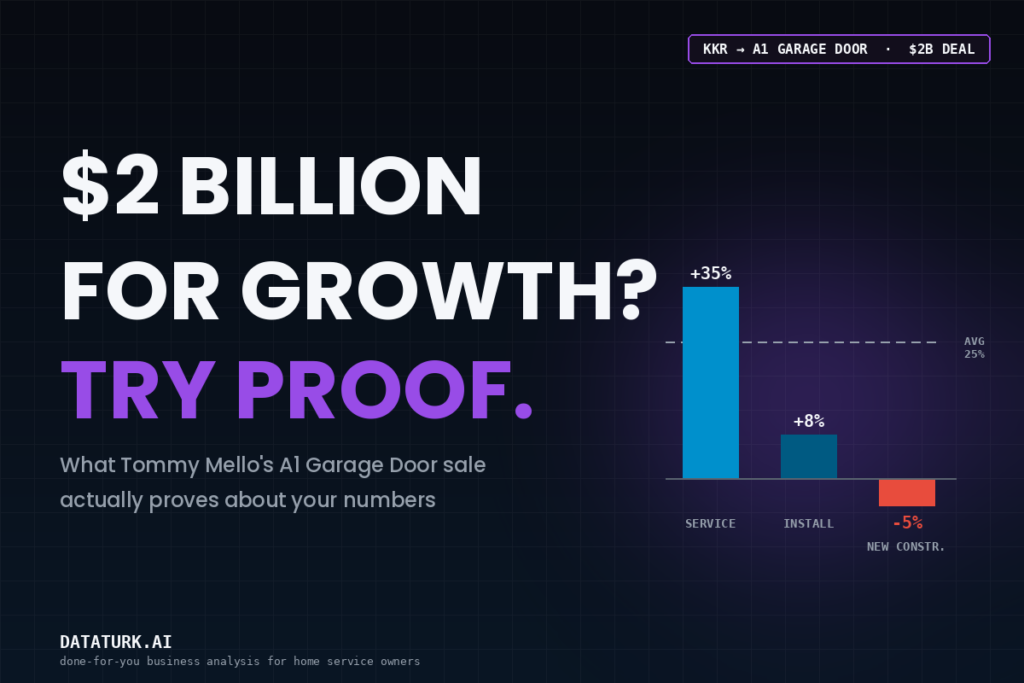
Tommy Mello just sold A1 Garage Door Service to KKR for around $2 billion.
Read that number twice. A garage door company. $2 billion.
If you run an HVAC, plumbing, electrical, or garage door business, your first reaction is probably the same one I’d have: good for him, wrong trade, wrong scale, doesn’t apply to me. Fair enough. But before you close the tab, look at the detail buried under the headline. A1 didn’t sell because it was big. It sold because when KKR’s team went digging, the numbers held up.
The Number Nobody’s Talking About
Here’s what actually happened, according to the reporting. A1 grew from roughly $74 million in revenue in 2021 to more than $200 million by 2026, operating across about 20 states with more than 700 employees. That’s real growth. But growth alone doesn’t get you a $2 billion offer. Garage-door platform valuations reportedly ran 12x to 16x EBITDA in 2026 — multiples that size go to businesses that can prove what they’re worth, not just claim it.
According to the analysis at Trade Vulcan, what actually made A1 sellable wasn’t its size. It was five things: 1) a consistent, 2) recognizable brand across every market; 3) measurable KPIs Mello tracked obsessively (booking rate, conversion rate, average ticket, customer acquisition cost); 4) documented systems that didn’t depend on tribal knowledge; 5) a management bench deep enough that the company didn’t need Mello in the room; and comparable data across 25-plus markets, meaning every branch measured success the same way.
Put plainly: buyers priced provable, job-level numbers. Not a revenue headline.
What $2 Billion Actually Buys
Most home service businesses aren’t running numbers that clean, and that’s true even for the profitable ones. More than half of home service businesses don’t run with a profit, according to April Sackfield of NumberConstruct and Fiscal Management Group — some aren’t even making enough to cover their bills. The trap looks the same everywhere: trucks rolling, dispatch board full, bank account empty.
Here’s what that actually looks like inside a business. One HVAC contractor discovered, job type by job type, that service calls were running a healthy 35 percent margin, installs were sitting at 8 percent, and a slice of new construction work was quietly losing 5 percent — while the blended number on the P&L still read 25 percent across the board. Nobody was lying on that P&L. Nobody had to be. A single blended average is enough to hide a losing line of business for years.
It gets worse when the numbers actually get tested. In one widely discussed case, a contractor bought a business that looked strong on paper and found out, on day one, before he’d changed a single thing, that he was already down 55 percent from what the seller’s records claimed — some of it because roughly 15 percent of reported revenue came from work that wasn’t legally billable the way it was billed. Nobody caught it earlier because nobody was really looking, not because it was hidden well.
The Gap Between What You Think and What’s True
This is the part worth sitting with. A1’s five-point playbook — brand, KPIs, systems, bench, comparable data — took Tommy Mello years and a small army to build. You don’t need to replicate all five to get the benefit of the first one: knowing whether your own numbers would hold up.
You almost certainly already have the raw data. It’s sitting in ServiceTitan and QuickBooks right now: job costs, labor hours, close rates, ticket sizes, branch-by-branch performance. The gap isn’t data. It’s that nobody’s pulling it apart by job type, by branch, or by tech, and checking whether the blended number is quietly covering for a losing category. That’s the exact gap a prioritization layer like DataTurk’s UpScore is built to close — not another dashboard with forty tiles, but a clear read on which of your numbers actually needs attention this week.
What to Actually Check This Week
You don’t need a $2 billion deal on the table to run this exercise. Pull last quarter’s completed jobs and do the following:
- Split gross margin by job type — service, install, new construction, or however your business breaks down — instead of relying on one blended number.
- Flag anything under 15 percent margin. That’s not a rounding error; it’s a category quietly funding a loss.
- Check labor burden against what you assumed it cost, not just the wage rate — burden is almost always higher than owners expect.
- Compare branch-to-branch or tech-to-tech performance using the same definitions across all locations, not whatever each manager happens to track.
- Ask what percentage of your “profit” is actually documented and provable if someone outside your business looked at it tomorrow.
None of this requires a buyer to show up. It requires being honest about whether your numbers would survive the kind of look A1’s numbers got.
The real question isn’t whether you’re ever going to sell for $2 billion. It’s whether, if someone pulled your real numbers apart by job type this week, they’d hold up — or surprise you.
Sources:
- A1 Garage Door Service Nears $2 Billion Sale to KKR — Hoodline
- $2 Billion for a Garage Door Company: What Contractors Should Learn From A1 — Trade Vulcan
- Busy But Broke: Why Your HVAC Business Loses Money on $150 Service Calls — HVAC Know It All
- HVAC Contractor Profit Margins: Why Your Books Are Lying to You — WhyteCPA
- Buying Then Losing a $2.1M HVAC Business — Acquiring Minds


