
You’ve Probably Already Ignored Five Emails About This
Somewhere in your inbox is another pitch about “AI SEO” or “getting found by ChatGPT.” You’ve probably deleted a few already, and I don’t blame you. Most home service business owners have heard enough promises from marketing companies to last a lifetime. But there’s a difference between dismissing a questionable sales pitch and overlooking the change someone is trying to sell you.
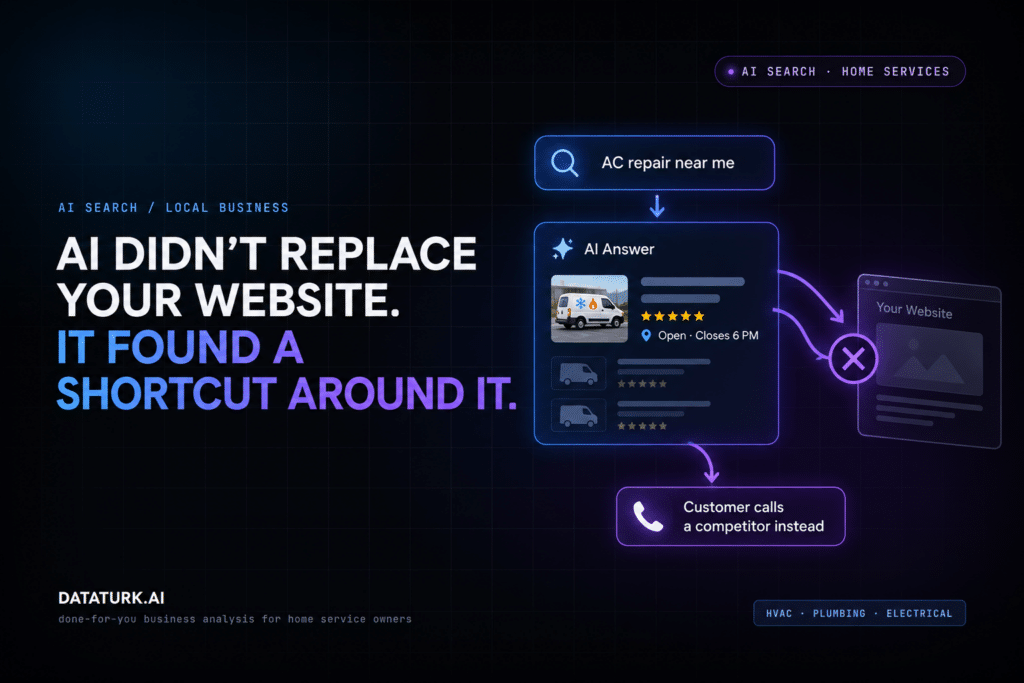
Consider a homeowner whose air conditioner quits on a Saturday afternoon. They ask Google who’s available to fix it nearby. Your company has technicians ready, but your Google Business Profile still lists your old Saturday hours. Google shows you’re closed, so the homeowner calls somebody else.
You never knew you were being considered. Nobody called your office, visited your website, or filled out a form. Your marketing reports won’t show an opportunity you lost because, as far as your tracking is concerned, that customer never existed.
That’s why this change is worth understanding.
Google Is Changing Where Customers Make Decisions
A research firm called Profound tracks the sources Google AI Mode uses to answer questions. Between April and June 2026, citations to Google’s own pages increased 8.4 times. Much of that growth came from Google Business Profiles and product knowledge panels, with home services among the industries that shifted the most.
For years, getting customers from Google to your website was a central goal of search marketing. Now Google can answer questions about your hours, services, location, and reputation before someone clicks through. Your website still matters, but it no longer controls every first impression.
A 2026 Scorpion survey found that 22 percent of homeowners use AI tools to research contractors or find recommendations. The same research found that 80 percent of home service business leaders don’t know how to appear in AI search results.
Those numbers expose an uncomfortable gap. Customers are adopting a new way to choose contractors, while most contractors don’t know how their businesses are represented.
But the bigger problem may be what you’re measuring. You can track calls, form submissions, website visits, and booked jobs. It’s much harder to measure the homeowner who ruled you out after reading an AI-generated answer and never contacted you.
Before You Buy AI SEO, Find Out What AI Is Selling About You
Here’s where the marketing conversation gets backward. Everyone wants to sell you more visibility, but visibility isn’t necessarily valuable if the information being shown is wrong.
If someone answering your phones told customers you didn’t offer water heater repairs when you did, you’d correct that immediately. You wouldn’t hire another marketing company to generate more calls before fixing the mistake.
Your online business information deserves the same attention.
Start by looking at your Google Business Profile as a stranger would. Check the hours, listed services, photos, and service areas. Then ask Google AI Mode and ChatGPT the kinds of questions homeowners ask when they need your services. See whether your company appears, what gets said about it, and which competitors are recommended. Try several searches because AI answers can vary.
Read your customer reviews, too. As local search expert Darren Shaw explains, AI systems can draw on the actual language in reviews and business responses. A five-star rating tells someone a customer was happy. A review describing the emergency repair, the technician’s arrival time, and how the problem was resolved tells a prospective customer considerably more.
Finally, ask new callers how they found you and what made them choose your company. You won’t capture every AI-influenced decision, but you’ll learn more about how customers are finding you than you will from another vendor promising to get you ranked.
AI search may eventually deserve its own marketing budget. For now, there’s a more immediate question worth answering.
What does Google or an AI tool tell your next customer about your business, and would you be comfortable hearing that same information from someone answering your phone?


