
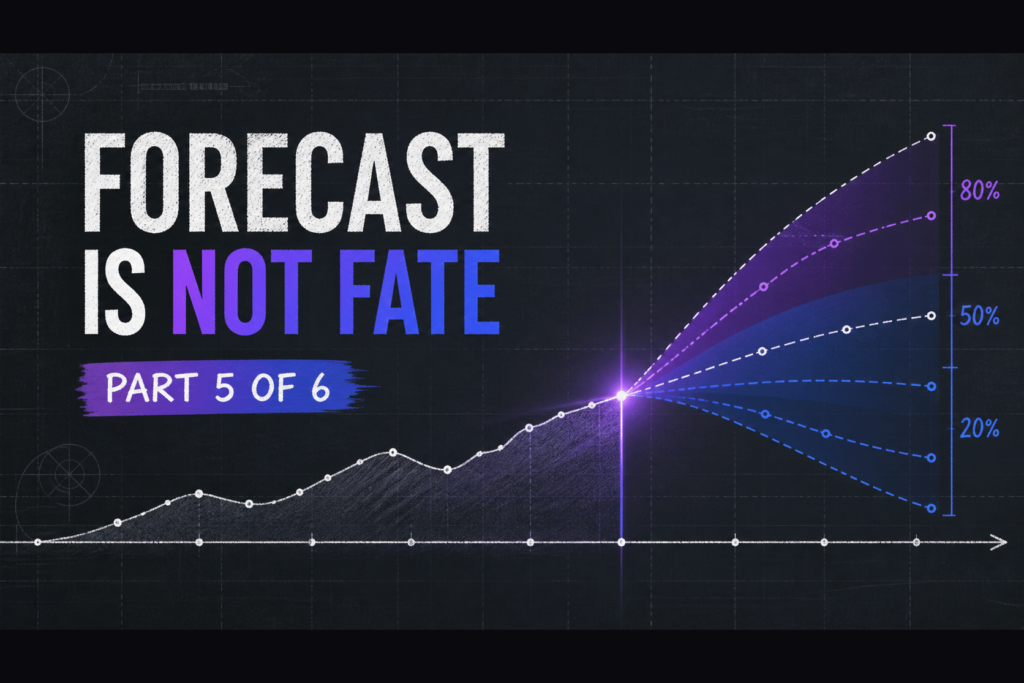
This is Part 5 of a six-part series on using AI to make better business decisions. We’ve defined the numbers, asked better questions, and learned to compare opportunities. Now we’re going to ask the question every business owner eventually wants answered: What happens next?
Ask AI how much revenue your company will do next year, and you may get an impressive answer.
$8,437,219.
That looks pretty official, doesn’t it?
Maybe you should start hiring. Buy five more trucks. Increase the marketing budget. Sign a bigger lease.
Before you spend the money, there’s another question you should ask:
“How did you come up with that number?”
A Forecast Is Built on Assumptions
Suppose your company did $7 million last year. You’re adding technicians, increasing the marketing budget, and working on your booking rate, so AI forecasts $8.4 million next year.
That forecast might be useful, but the $8.4 million isn’t sitting somewhere in the future waiting for you to arrive.
AI had to make assumptions.
How many calls will your marketing produce? What will those calls cost? What percentage will your CSRs book? How many technicians will you have? How many calls can they run? What will your close rate and average ticket look like?
Change those assumptions, and you change the forecast.
Suppose the plan calls for hiring four technicians by March, but you don’t find them until June. Revenue changes.
Suppose marketing produces the expected number of leads, but your cost per lead rises 20%. Profit changes.
Suppose your booking rate improves faster than expected, but you don’t have enough technicians to run the additional calls. The forecast changes again.
That doesn’t make forecasting useless. It makes understanding the forecast useful.
Don’t Ask for One Future
Instead of asking AI, “What will our revenue be next year?” ask it to show you what could happen under different conditions.
What happens if we keep performing exactly as we are now?
What happens if we hire the technicians we planned to hire and improve booking rate by five points?
What happens if marketing costs rise?
What happens if we can’t hire fast enough?
Now you aren’t getting one impressive-looking number. You’re seeing several possible outcomes and what needs to happen for each one to become possible.
That gives you something you can manage.
If the growth plan depends on hiring four technicians by March, you know hiring deserves attention now. If the plan depends on improving booking rate from 64% to 78%, you can track whether that improvement is actually happening.
The forecast stops being a promise and starts becoming a plan you can check.
Keep Updating the Answer
A useful forecast should change when the business changes.
If January comes in stronger than expected, update it. If hiring falls behind, update it. If a marketing source stops producing, update it.
AI can make this much easier because it can keep comparing what you expected with what actually happened.
That may be far more useful than pretending the first prediction was right.
The question isn’t, “Did AI correctly predict our revenue twelve months ago?”
A better question is, “Based on what we know today, what should we expect now, and what would need to change to produce a better result?”
That brings us to the final article in this series.
AI can help you understand what happened, identify opportunities and estimate what may happen next. Eventually, though, someone has to decide what to do.
In Part 6, “AI Can Give Advice. You Still Have to Make the Decision,” we’ll look at where the computer’s job should end, and the business owner’s job begins.
The Most Important Questions Aren’t the Ones You Ask AI
- The Most Important Questions Aren’t the Ones You Ask AI
- Your Booking Rate May Not Mean What You Think It Means
- AI Can Give You a Good Answer to the Wrong Question
- More Numbers Do Not Always Lead to Better Decisions
- AI Can Guess the Future. It Cannot Know the Future (You are here)
- AI Can Give Advice. You Still Have to Make the Decision
Previous Article: More Numbers Do Not Always Lead to Better Decisions | Next Article: AI Can Give Advice. You Still Have to Make the Decision


