
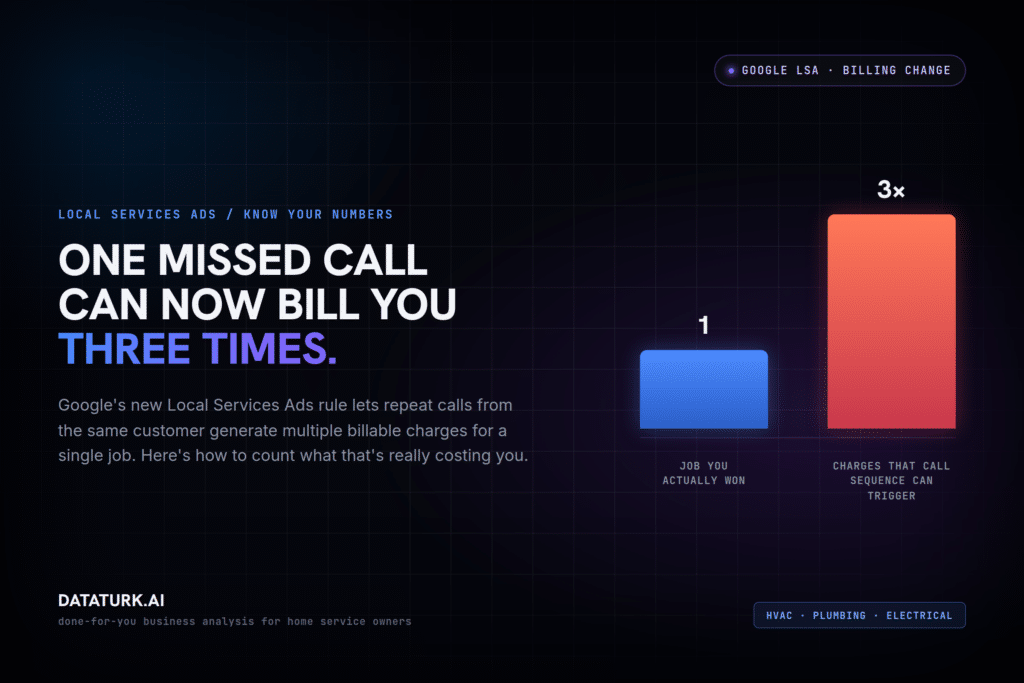
If you run a home service company and use Google’s Local Services Ads, you already know something changed on October 1. Google started charging you for calls you never actually answered, as long as the caller stayed on the line for more than twenty seconds. That part has been covered everywhere, including in our own look at the policy. What most of that coverage has missed is what could cost you even more. The rule does not always charge you just once.
You Probably Already Heard About This Rule
Google’s Local Services Ads program now treats a missed call as a billable lead if the caller stays on the line for more than twenty seconds during business hours. We wrote about the mechanics of that policy last week, including how business hours and keypad routing affect the clock, along with what to do about staffing and call routing. If you want the full breakdown, read it here.
This article picks up where that one left off, because another part of the rule has much less to do with staffing and much more to do with how customers behave when they need help.
The Call Every Owner Has Gotten Three Times in One Morning
Think about a typical emergency call. It is a hot afternoon and someone’s air conditioner just quit. They call you first. Nobody picks up fast enough, so they hang up after twenty-some seconds and try the next company on their list. A few minutes later, they still have not found anyone, so they call you again—same result. Ten minutes after that, they try one more time and finally reach someone.
You win the job, which feels like a win. From the customer’s point of view, it is. From your LSA bill, it may look a little different.
One Customer. One Job. Possibly Three Bills.
The rule does not necessarily charge you once for that customer. It can charge you for each qualifying call in the sequence.
Under the policy, when the same customer calls more than once, and those calls meet Google’s billing criteria, more than one call can become a chargeable lead. So those three attempts are not automatically treated as one customer event. They may become two or three separate charges tied to the same homeowner and the same job.
That matters because you were only going to win one job either way. Google also hasn’t publicly explained whether a missed call costs the same as a call that turns into a booked job, which makes the real cost harder to predict.
Your Most Urgent Jobs May Also Become Your Most Expensive Ones
This is where the rule matters most for home service companies. Customers most likely to call two or three times usually aren’t calling about routine maintenance. They are calling because something is wrong now.
The furnace is dead in January. The basement is filling with water. The air conditioner stopped working on a 100-degree afternoon. Those customers keep calling because waiting until tomorrow is not really an option.
That means the new rule can make urgency more expensive, even though urgency is one of the reasons these customers are valuable in the first place.
That is a difficult cost to plan around. The jobs where fast response matters most are also the jobs most likely to generate another call before someone finally answers.
The Number Nobody Is Counting Yet
Most of the advice around this rule has focused on answering faster. Better staffing helps. Smarter call routing helps. Faster callbacks help too, and our earlier article covers those pieces.
But none of that tells you how much exposure you already have to repeat-call billing, because that number isn’t in your staffing schedule. It is sitting in your call log.
Pull the last 30 days of calls from your phone system or ServiceTitan. Instead of looking only at total calls or missed calls, look for the same phone number appearing more than once on the same day. That is a repeat-call sequence. Count how many of those sequences happened, then count how many calls were inside each one.
That number may tell you more about your real exposure than your missed-call rate alone.
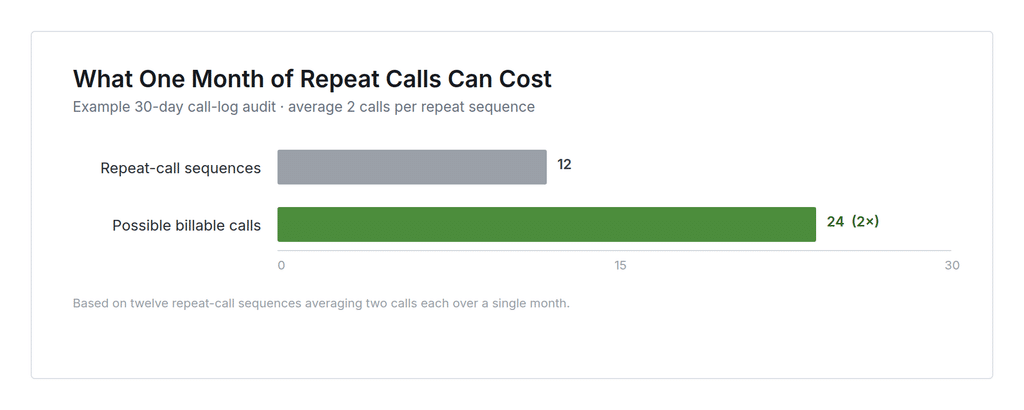
For example, if you find twelve repeat-call sequences in a month with an average of two calls in each sequence, you are not looking at twelve possible billable calls. You may be looking at something closer to twenty-four. Running that count before your next bill arrives gives you something far more useful than a surprise. It gives you a number you can watch.

A Better Question Than “Did We Answer the Phone?”
“Did we answer the phone?” is the question most owners are asking right now, and it is a fair one. But it may only tell you part of what this new rule can cost.
A better question is how often your customers call more than once before you answer, and what those repeat calls could now cost you.
Your urgency has always been valuable to your customers. Under this new rule, that same urgency may also become more valuable to Google, whether you answer the first call or not.
If this changes how you look at your call log, start there. Count the repeat calls before Google counts them for you.


