
Your trucks are still rolling, your techs are still working, and your CSRs are still taking calls, yet revenue doesn’t feel as strong as it should. When that happens, most owners reach for the same explanation: business is slow. Maybe it is, but that answer comes too early.
Revenue is the last number in a much longer story. Before revenue shows up, someone has to need service, find your company, call, get classified correctly, book, get dispatched, give the technician a real opportunity to solve the problem, approve the work, and spend enough for the job to produce the revenue you expected. If any part of that process changes, the final revenue number changes with it, which means calling all of that “slow” lumps several very different problems under the same name.
The Market Is Not Giving Us One Simple Answer
There was good reason to worry about HVAC demand in 2025. Shipments of central air conditioners and heat pumps fell hard during parts of the year, and contractors that depended heavily on replacement work felt it.
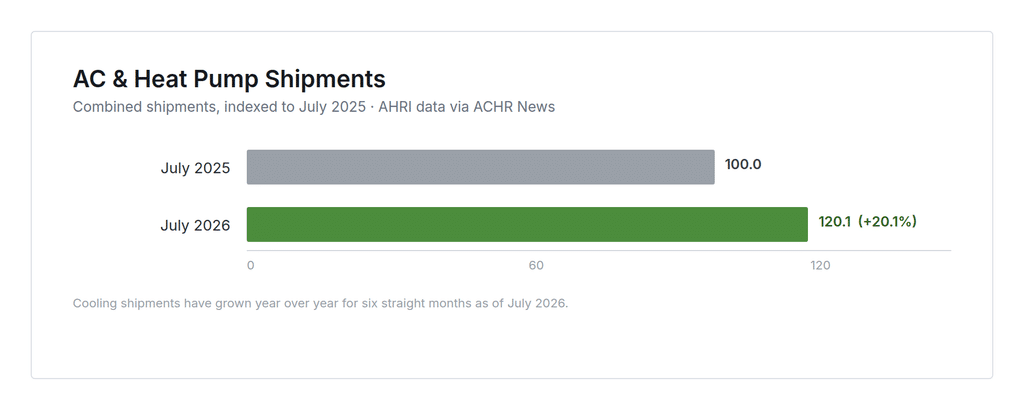
The latest numbers make the picture less simple. In July 2026, combined air conditioner and heat pump shipments were up 20.1 percent from July 2025, and cooling shipments had increased year over year for six straight months, according to AHRI data reported by ACHR News.
Search behavior adds another useful clue. A recent U.S. keyword study using Google Trends and search volume data found that over the previous 12 months, relative search interest for “ac repair” averaged 51 compared with 16 for “ac installation.” Search volume for “ac repair” reached an estimated 673,000 searches in July 2026. These are vendor estimates, so treat them as a signal of interest rather than a count of booked jobs, but they still show people are looking for HVAC help. See the HVAC search data.
None of that proves every contractor should be having a strong year, but it does suggest “the whole market is down” may not tell the whole story.
Repair Is Becoming More Important
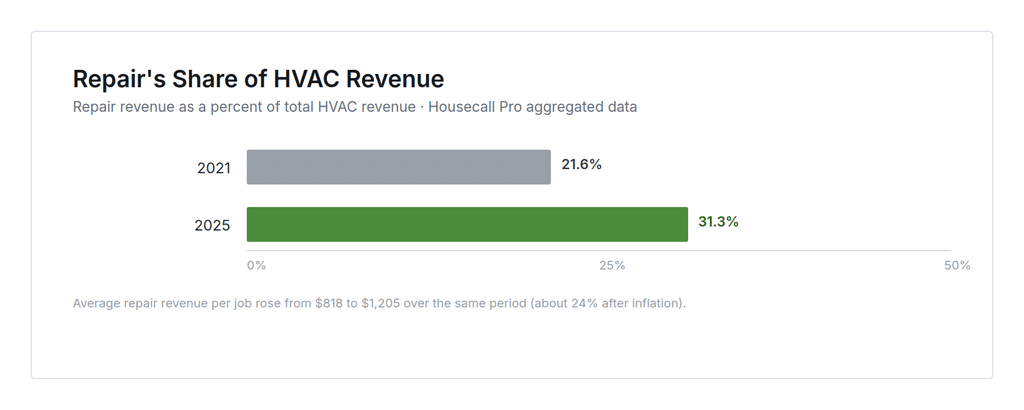
The repair data gives us another reason not to treat lower replacement demand as the whole story. Housecall Pro’s aggregated HVAC data shows repair revenue rising from 21.6 percent of total revenue in 2021 to 31.3 percent in 2025.
Repairs per company climbed from about 103 a year in 2022 to more than 170 in 2025, while average repair revenue per job increased from $818 to $1,205. Even after inflation, Housecall Pro estimates that increase at about 24 percent. Its 2026 State of Home Service Spending report also found that repairs represented about 88 percent of HVAC jobs in Q1.
The numbers do not prove replacement dollars moved into repair, but they do show repair is taking a larger share of HVAC revenue. That matters because softer replacement demand does not always mean fewer opportunities overall.
Revenue Can Tell You Something Is Wrong Without Telling You What
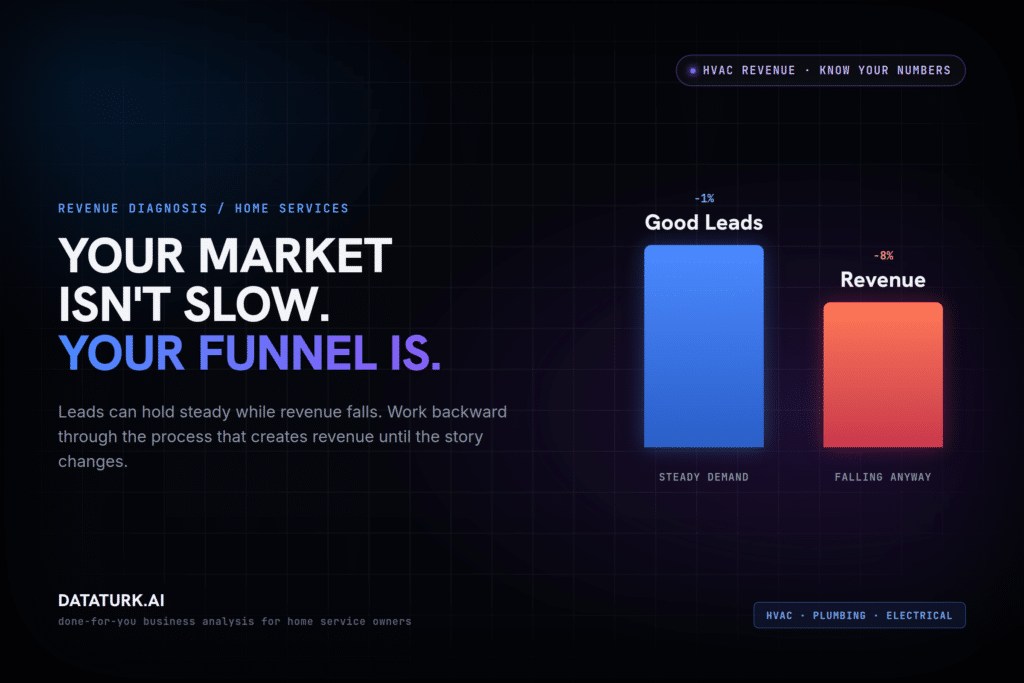
Imagine revenue is down 8 percent from last year, but good lead volume is down only 1 percent. Demand isn’t the whole problem, so the other 7 percent has to be explained elsewhere in the process. For example, if 100 good leads used to produce 70 booked jobs and now produce 60, buying more leads only feeds the leak.
The gap could also be in technician opportunity, conversion, or job value, and each one calls for a different fix. That is why blaming a slow market too early can get expensive: you may spend time and money solving a demand problem that isn’t actually the problem you have.
Work Backward Until the Story Changes
A more useful way to look at a slow year is to start with revenue and work backward through the process that created it. If revenue is down, look at the quality and value of the revenue first. Has the mix of repair and replacement changed? Has average revenue per opportunity changed? Are you making roughly the same amount when customers say yes?
From there, look at conversion. If conversion is healthy, look at how many real opportunities your technicians had to sell. If that number looks normal, keep moving backward through dispatch, booking, lead classification, and lead volume until you find the first place where this year’s story stops matching last year’s.
That matters more than finding the worst-looking percentage on a report. A metric can look weak and still have little effect on revenue, while a smaller change elsewhere can cost the company far more. The point is not to fix every number. The point is to understand which number deserves your attention first.
Market Data Gives You Context. Your Business Data Gives You the Answer.
Industry reports can tell you whether replacement shipments are up or down. Google Trends can show whether homeowners are still searching for repair. Benchmarks can tell you how repair tickets, job volume, and revenue mix are changing across other businesses, but none of them know what happened after a customer reached your company.
Your own ServiceTitan data gets much closer to that answer. If good leads are down sharply, you may have a real demand or marketing problem. If good leads are steady but booking is down, the problem has already moved inside the business. If bookings are healthy and revenue is still slipping, keep following the customer through the process until you find where the numbers changed.
That is the thinking behind UpScore at DataTurk.ai. It uses your ServiceTitan data to help show where the revenue process changed and where an improvement may have the most financial impact. The point is not another dashboard full of numbers. It helps answer a more useful question: where should I look first?
Before You Blame the Market, Find the Break
Sometimes the answer really will be demand. Some markets have fewer homeowners calling, fewer replacements happening, and fewer good opportunities for contractors than before. Lower revenue, however, does not prove that is what happened to you.
Outside data is already telling a more complicated story. Repair has become a larger part of HVAC revenue, homeowners are still searching heavily for HVAC repair, and equipment shipments have begun recovering from last year’s decline. Your business may be following those trends, or it may be doing something completely different.
The only way to know what is really happening is to start with revenue and work backward through the numbers that produced it. Somewhere along that path, the story usually changes, and once you find where it changed, you have a much better idea of what actually needs your attention.
Maybe you really do need more demand. Or maybe the demand is there, and you are getting less revenue from it than you were before. Both can leave you staring at the same disappointing bank balance, but they are very different problems to solve.


