
You’ve probably added some new technology to the business this year. It might answer the phones after hours, help dispatch reroute jobs, or handle simple quotes when your CSRs are tied up.
At the time, it probably made sense. Maybe a vendor showed you what it could do, or another contractor told you what they were using. And with all the talk about AI, sitting on the sidelines started to feel like a risk in itself.
But after you’ve paid for the tool and used it for a few months, the conversation changes. You don’t need another demo or another list of things it can do. You need to know whether it’s actually doing anything for your business.
And that’s where a lot of owners get stuck. They know whether they like the tool. They just don’t have a number that tells them whether it’s paying off.
Everyone Says You Need AI. So You Tried It.
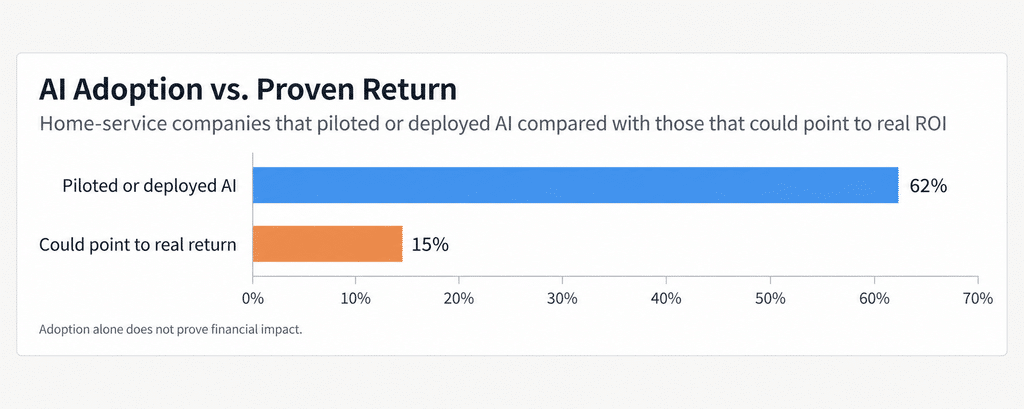
AI is changing the home services business. ServiceTitan surveyed more than 1,000 commercial trades companies and found that 62 percent had already piloted or deployed some form of AI.
Johnny Baker, COO of an HVAC and plumbing contractor, explained why many owners feel the need to move now. “We’re wading into the AI waters because it’s coming, and in many ways, it’s already here. And the longer we delay that, the farther behind the curve we are.”
Trying AI makes sense. The problem is knowing what happened after you tried it.
62% Tried AI. Only 15% Can Prove It Paid Off.
That same ServiceTitan survey found that only 15 percent of contractors who tried AI could point to a real return. That’s a big gap between using a tool and knowing it paid off.
The residential side tells a similar story. A separate ServiceTitan study of residential contractors found that 74 percent believe AI is key to running an efficient shop. Only 25 percent are using it in a way that shows up in their numbers, and nearly half don’t fully trust it yet.
That doesn’t mean AI isn’t working. Among contractors using it, 48 percent reported productivity gains and 45 percent reported time savings. The tools can produce results. The harder part is knowing what they produced in your business.
The Problem May Not Be the Tool. It’s What You Measured.
Jimmy Thompson, who sells software to HVAC and plumbing businesses, puts it in terms every owner understands: “I always tie things back to dollars and cents. Is it making you money? If you’re not sure, the answer is probably no.”
Most owners didn’t buy the tool and decide the numbers didn’t matter. They started using it without first getting a clear picture of where things stood. A few months later, there’s nothing solid to compare against.
You’d never do that with a new technician. You already know what a good tech looks like in your shop, so you watch what matters: callback rate, average ticket, close rate and the amount of work they actually produce. After a few weeks, you have a pretty good idea whether that hire is making you money.
A new piece of software shouldn’t get a different standard. If you’re paying for it every month, there should be something in the business you can point to and say, “That got better.”
That matters even more when 40 percent of contractors rank cash flow among their top three goals, up from 28 percent a year ago, and 73 percent say tariffs have already hit their business. When cash is tight, every monthly expense has to earn its place.
Give Every Tool One Number to Move.
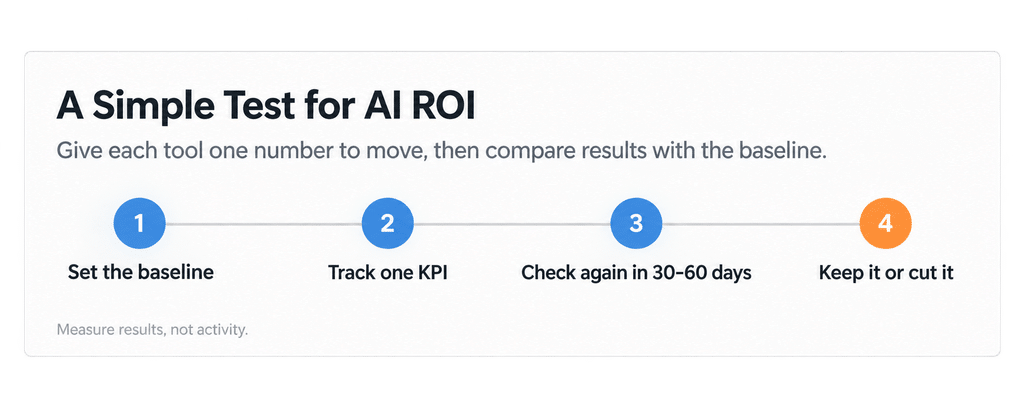
You don’t need a complicated way to measure this. Start with why you bought the tool in the first place. What was it supposed to make better?
If it’s answering your phones, maybe you expected to book more calls. If it’s helping with dispatch, consider less drive time or more jobs per tech. If it’s helping your sales team, you might be looking for a better close rate or a higher average ticket. Whatever the reason, it should tie to a number.
Find that number in ServiceTitan, QuickBooks or wherever you normally track it. See where it is now, then look at it again in 30 to 60 days. You don’t need the tool to perform a miracle. You just need to see enough improvement to make the cost worthwhile.
That’s a much easier way to think about AI. Instead of asking whether your business should be using it, ask what would have to improve for this particular tool to be worth paying for.
Before You Buy Another Tool, Know What “Working” Looks Like.
You already do this in other parts of the business. You know what a truck costs you. You know what you’re paying for leads. And you know pretty quickly when a new tech isn’t producing. Software shouldn’t be any harder to judge.
That’s the thinking behind UpScore. It shows you where the business stands today and where money may be slipping away. Then, when you change something, you have a real starting point to measure against instead of trying to remember how things felt three months ago.
Many owners find a gap on their first look that’s worth more than what they’ll spend on UpScore for the next couple of years. And when you add another AI tool, change your marketing or make another investment in the business, you’ll have a much better way to know if it paid off.
See what UpScore would show you. Visit dataturk.ai.


